
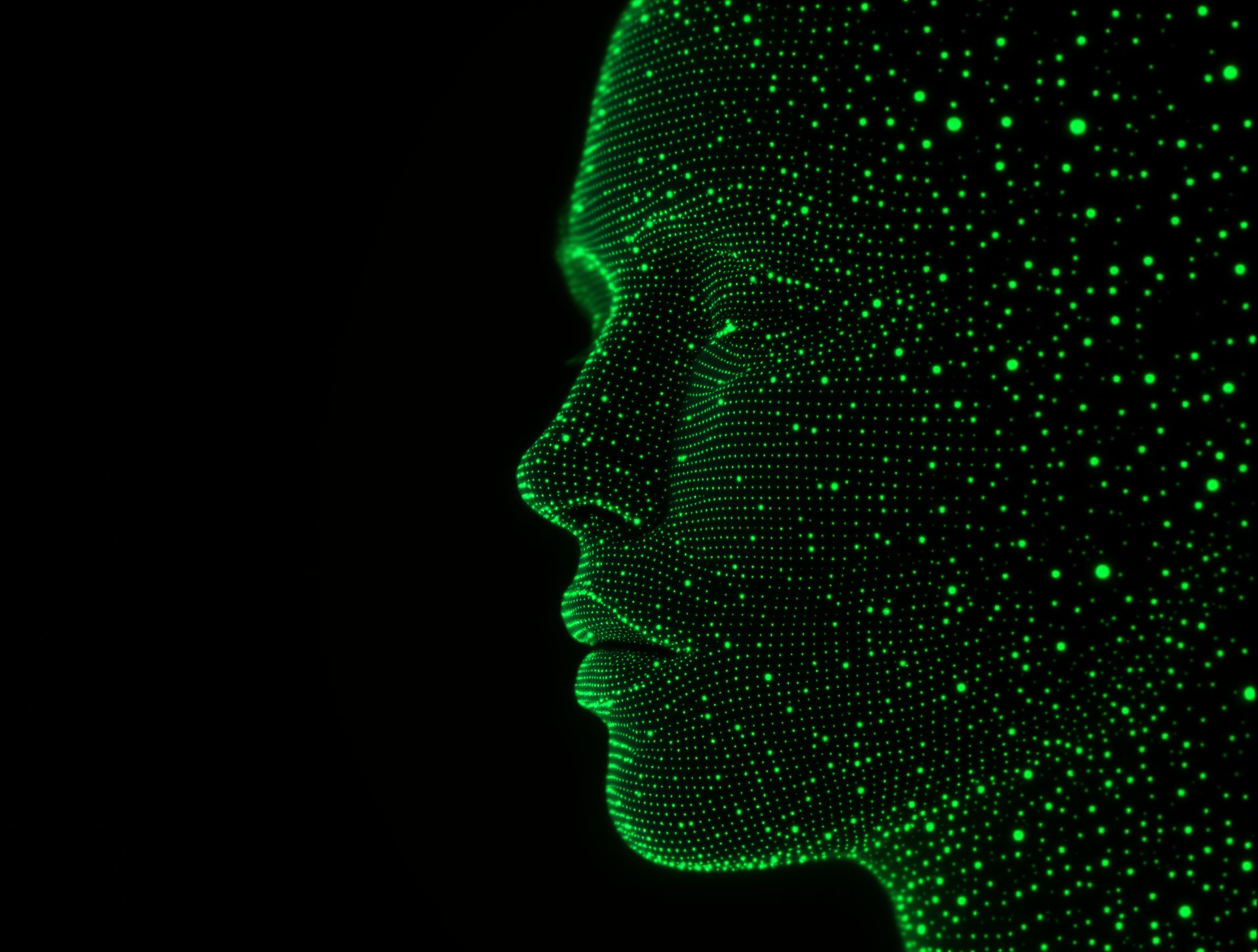
Face Recognition
AI-Powered Biometric Identification.
Detect, analyze and recognize faces in real time — from high-end servers to resource-constrained microcontrollers. id3's face recognition algorithms are continuously evaluated by NIST and deployed in mission-critical applications worldwide.
Explore Face SDKRecognition Pipeline
Every face recognition transaction follows the same deterministic sequence — from raw image to trusted decision.
Choose Your Integration
The same algorithm family, packaged for every deployment context — from on-device MCUs to cloud APIs.
Face SDK
Native library in C, C++, C#, Java, Python, Swift, Kotlin and Dart. Full pipeline: detection, liveness, extraction, matching.
Face API
REST web service — integrate face recognition into any stack without SDK dependencies. Ideal for web backends and microservices.
MicroFace SDK
Optimized for microcontrollers with NPU acceleration. Runs on STM32N6 and i.MX 8M Plus with <60 ms latency.
Match-on-Card SDK
Biometric matching runs entirely on the smart card — no network, no server, no database. Maximum privacy by design.
NIST FRTE Evaluation
id3 Technologies face recognition algorithm has proven excellent tradeoff between accuracy, speed and template size in the NIST ongoing Face Recognition Technology Evaluation (FRTE).
Application Domains
Face recognition powers critical workflows across public safety, identity management, healthcare and enterprise security.
Access Control
Secure, contactless entry for buildings, data centers and restricted zones. No card, no PIN — just your face.
Border Control
Automated e-gate identity verification against ePassport and visa databases at ports of entry.
Identity Enrollment
KYC and digital onboarding with ICAO-compliant facial capture, liveness check, and document cross-matching.
Online Authentication
Selfie-based login and transaction confirmation for banking, insurance and government portals — no hardware token needed.
Law Enforcement
Large-scale investigation search, de-duplication of watchlists, and real-time surveillance analytics for public safety agencies.
Healthcare
Frictionless patient identification at reception, secure access to medical records, and staff authentication in clinical environments.
Why id3 Technologies
Real-Time Performance
9 ms on mobile, 45 ms for 1 million faces on GPU. Algorithms optimized for both latency-critical and throughput-intensive scenarios.
Any Platform
From cloud servers and React web apps to iOS/Android and bare-metal MCUs — one algorithm family, consistent accuracy across all deployments.
Data Sovereignty
Deploy fully on-premise or air-gapped. With Match-on-Card, biometric data never leaves the physical credential — GDPR-compliant by architecture, not policy.
35+ Years in Biometrics
Founded in 1990, id3 has shipped biometric technology to governments, banks, and system integrators in 20+ countries. Deep domain expertise, not a startup pivot.
Frequently Asked Questions
Everything you need to know about id3's face recognition technology.
01 What is face recognition technology?
Face recognition is a biometric modality that identifies or verifies a person from their facial features. It captures an image, extracts a compact mathematical template, and compares it against a reference — either a stored template (verification) or a database (identification).
02 How accurate is id3's face recognition?
id3 algorithms achieve a False Non-Match Rate of 0.5% at a False Match Rate of 0.000001 (1-in-a-million), as measured in the NIST FRTE evaluation. Matching 1 million templates takes approximately 45 ms on a GPU.
03 Does it work on embedded or mobile devices?
Yes. The MicroFace SDK targets microcontrollers (STM32N6, i.MX 8M Plus) and achieves face recognition in under 60 ms on dedicated NPUs. The Face SDK runs in 9 ms on an iPhone 12.
04 How is liveness detection handled?
id3's Face SDK includes both passive liveness (single selfie, no user action required) and active liveness (challenge-response). Both modes detect spoofing attacks — printed photos, replayed videos, and 3D masks.
05 Is biometric data stored on a central server?
Not necessarily. With Match-on-Card, the biometric template is stored and matched directly on a smart card — no server, no database. For server-based scenarios, only the compact template (140–268 bytes) is stored, never raw images.
06 What regulations does id3 comply with?
id3 Technologies' products are designed with GDPR and ICAO 9303 (travel document facial image standards) compliance in mind.
Get started with our technologies.
Contact us to learn more about our biometric and security solutions and discover how it can transform your products and services. With id3 Technologies, step into a world where technology meets security, innovation, and reliability.
Contact us